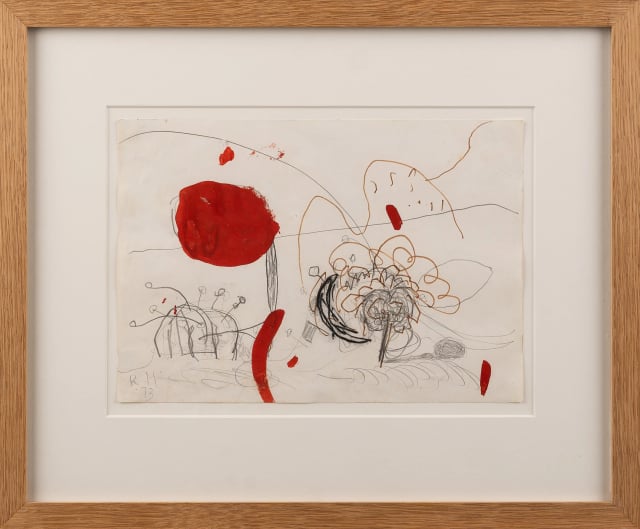
Untitled

Roger Hilton was one of the most important British abstract painters of the post-war period and a central figure in the development of abstraction associated with St Ives. Although initially influenced by European modernism, particularly the work of Piet Mondrian, Hilton developed a highly individual visual language in which spontaneous line, simplified forms and areas of intense colour combine with an instinctive sense of space. He became closely associated with the artists of St Ives and was elected a member of the Penwith Society of Arts in 1957.
This untitled work dates from 1973, during the remarkable final period of Hilton’s career. By this time, declining health increasingly confined him to his home at Botallack in west Cornwall, and he turned extensively to works on paper. These late compositions possess an extraordinary freedom and immediacy, combining drawing and painting in a language that can appear simultaneously abstract, figurative and almost childlike.
Here, vivid passages of red punctuate a delicate network of pencil and crayon lines, while the sweeping black form at the centre provides a strong visual anchor. Suggestive shapes emerge and dissolve across the sheet without resolving into a conventional landscape or figure. The resulting composition has the spontaneity and economy characteristic of Hilton’s late work, in which apparently simple gestures are balanced by a sophisticated understanding of colour and pictorial space.
Within Sharpe Fine Art’s exhibition narrative, Moving to Modernism – Arriving at Abstraction, Hilton occupies an important position at the heart of post-war British abstraction. Alongside artists including Terry Frost, Patrick Heron, Peter Lanyon and William Gear, his work demonstrates how British artists absorbed the lessons of European modernism while developing a distinctive and increasingly liberated approach to abstract painting. This intimate 1973 work captures the remarkable vitality and freedom of Hilton’s final years and provides a direct connection to one of the most significant figures of the St Ives movement.