Peter Lanyon
Peter Lanyon (1918 – 1964) was one of the most important figures in post-war British art and the artist who carried the St Ives School into a new era of abstraction. Born and raised in St Ives, he studied under Ben Nicholson before developing a highly individual style that combined the principles of modernism with a profound understanding of the Cornish landscape. Unlike many abstract artists, Lanyon never abandoned nature; instead, he sought to express the experience of landscape through movement, colour and form. His pioneering glider flights over Cornwall further transformed his work, inspiring paintings that explored space, light and the sensation of flight in entirely new ways.
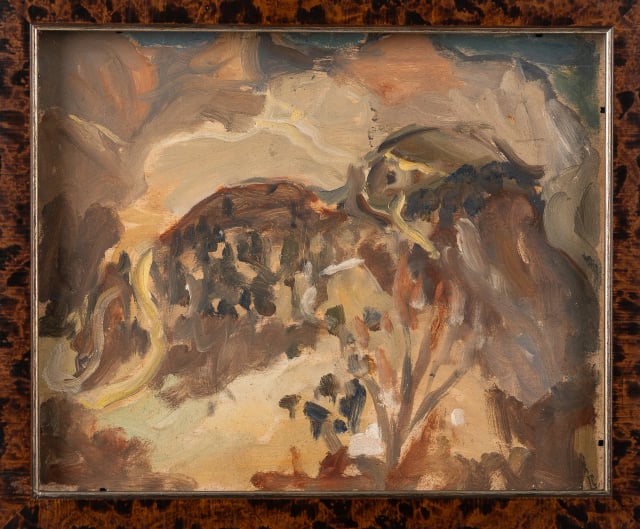
Lanyon’s paintings, drawings and prints are characterised by their extraordinary energy and complexity. Layered brushwork, expressive marks and shifting planes of colour evoke the physical experience of cliffs, fields, sea and sky rather than their literal appearance. His work attracted international recognition during his lifetime, particularly in the United States, establishing him as one of Britain’s leading abstract painters.
Within Sharpe Fine Art’s exhibition narrative, Moving to Modernism – Arriving at Abstraction, Peter Lanyon occupies a defining position. The collection traces his remarkable artistic journey, from rare early representational works that reveal his formative years to increasingly ambitious abstract compositions that transformed the language of British landscape painting. Exceptional provenance, including works retained within the Lanyon family and documented in the catalogue raisonné, allows visitors to follow this evolution with unusual clarity. More than any other artist in the collection, Lanyon demonstrates that abstraction did not emerge through the rejection of landscape, but through a deeper immersion in it. His work forms the emotional and intellectual centre of the Sharpe Fine Art collection, embodying the exhibition’s central idea that modernism was not a break with the past, but its natural evolution.