Ben Nicholson
Ben Nicholson OM (1894–1982) was one of the most influential figures in twentieth-century British art, playing a pivotal role in the development of modernism in Britain. The son of painters Sir William Nicholson and Mabel Pryde, he emerged during the 1920s before becoming a leading advocate for abstraction. His friendship with Christopher Wood and his encounter with the self-taught Cornish fisherman Alfred Wallis in St Ives profoundly shaped his artistic vision, encouraging a move towards simplicity, structure and the essential forms of landscape and everyday objects.
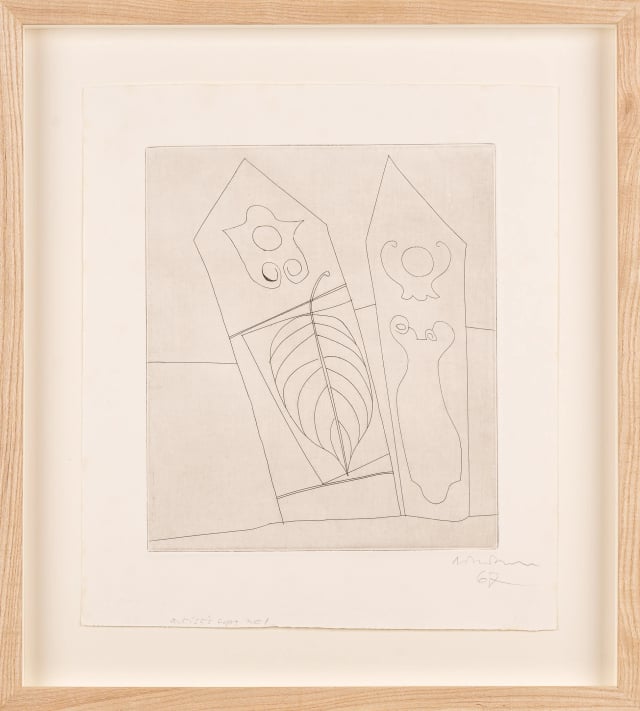
Throughout his career, Nicholson explored painting, relief sculpture, drawing and printmaking with remarkable clarity and precision. Whether depicting bottles, jugs and landscapes or pursuing pure abstraction, his work sought harmony through carefully balanced line, geometry and space. His abstract reliefs and later prints became defining images of British modernism and established his international reputation, while his influence extended across Europe through his association with artists including Barbara Hepworth, Piet Mondrian and Naum Gabo.
Within Sharpe Fine Art’s exhibition narrative, Moving to Modernism – Arriving at Abstraction, Ben Nicholson represents the pivotal turning point in the story. More than any other artist, he bridges traditional landscape painting and pure abstraction. His work demonstrates how observation was gradually distilled into form, line and structure, laying the foundations for the St Ives School and influencing generations of artists including Peter Lanyon, Terry Frost and Patrick Heron. Nicholson’s prints and drawings remain among the clearest expressions of modern British art and stand at the very centre of the Sharpe Fine Art collection.