Terry Frost
Sir Terry Frost RA (1915–2003) remains one of the most widely celebrated, joyful, and pioneering figures of the post-war St Ives avant-garde. Discovered while painting in a prisoner of war camp during the Second World War, Frost relocated to Cornwall in 1946 under the direct encouragement of Ben Nicholson. He spent a lifetime capturing the unique clarity of light, colour, and motion unique to the West Country coastline. Knighted in 1998 for his services to art, Frost rejected cold, academic abstraction, choosing instead to create a vibrant, sensory language built around simple circles, semicircles, and interlocking crescents.
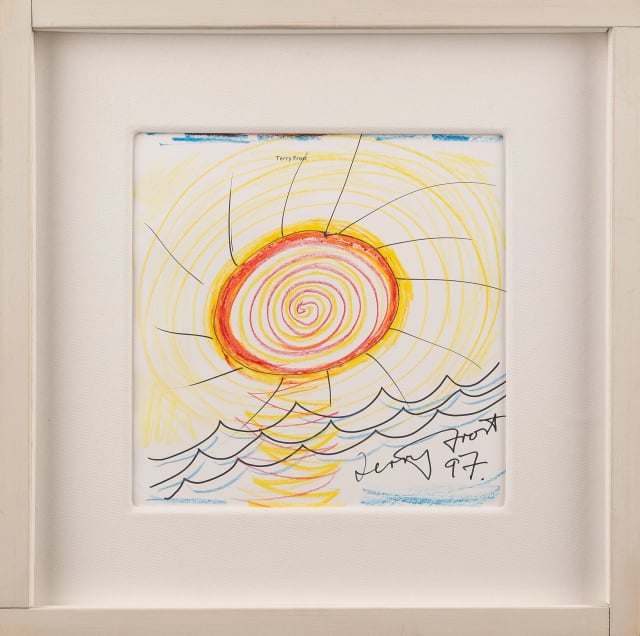
Within our overarching exhibition narrative, Moving to Modernism — Arriving at Abstraction, Frost’s work represents the ultimate celebration of the sensory world. His works on paper functioned as an essential, high-impact studio laboratory. Rather than setting up a traditional easel to record a realistic, photographic landscape, Frost used fluid markers, pastels, and crayons to map out the underlying structural rhythm of nature. His drawings act as direct, kinetic blueprints where he calculated exactly how blinding solar light and water currents would collide before executing them as monumental museum canvases and architectural tapestries.