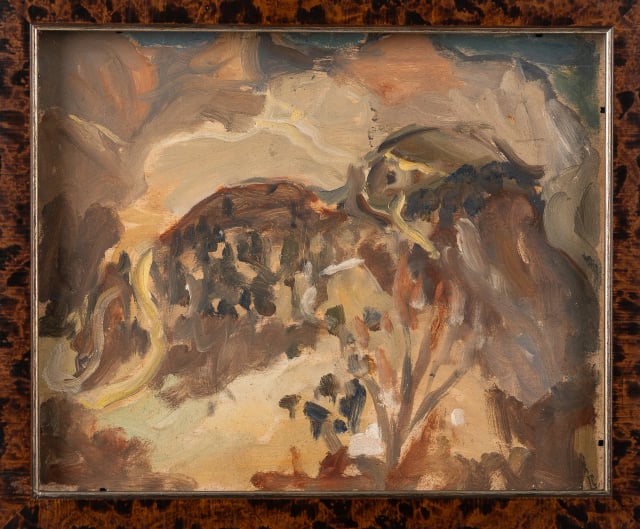
Pink House in Woods / Mountains

The Threshold of Abstraction: Materiality and Modernism in Peter Lanyon’s Pre-War Transition: This rare, double-sided oil on board by Peter Lanyon (1918–1964) represents a vital and deeply intimate look into the foundational pre-war years of one of the monumental titans of the St Ives School and Post-War British abstraction. Painted between 1938 and 1939, this artwork dates to the very dawn of Lanyon’s career when artists working in West Cornwall frequently flipped scarce boards to maximise studio materials. Measuring 32cm x 40cm, this exquisite piece comes directly from The Estate of Peter Lanyon via the distinguished Joan Fry Collection, serving as a pristine visual document of a young master on the precipice of discovery.
The Physicality of the Board: A Studio Economy: In the late 1930s, West Cornwall was not yet the international capital of avant-garde abstraction it would become in the post-war era; it was a rugged, isolated outpost where traditional landscape painters and a small circle of modernists worked side-by-side. Art supplies were a luxury, and for a young Lanyon, the physical economy of the double-sided board was a practical necessity. Yet, this material constraint created an object of immense historical power. The dual sides do not simply conserve materials—they capture a literal and intellectual turning point, offering a direct view into the competing artistic dialects that Lanyon was wrestling with in his formative studio practice.
The “Mountains” Side and the Euston Road Dialectic: The side featuring the Mountains composition bears Lanyon’s early monogram in the lower right corner, showcasing a work of controlled structure, measured lines, and a restrained palette. The earth tones, muted browns, and pale ochres reveal the direct influence of the Euston Road School, where Lanyon studied briefly under Victor Pasmore in London in 1937. The Euston Road philosophy advocated for a sober, objective realism based on careful measurement and tonal observation, acting as a deliberate counterweight to the emotional chaos of Surrealism and the complete detachment of pure abstraction. In Mountains, Lanyon applies this training to the land, balancing the rolling, rhythmic contours of the hills with a subtle, underlying geometric stability. It is a native Cornishman observing his terrain through a highly disciplined, analytical lens.
“Pink House in Woods” and the Roots of Topographical Abstraction: On the reverse side, titled Pink House in Woods, Lanyon begins to shed his academic restraints and move toward a highly personal, expressive vocabulary. While the scene remains representational—depicting a building nestled into a dense, sloping valley—the application of the oil paint changes dramatically. The brushwork becomes looser, thicker, and deeply tactile. The trees and foliage are built up with a rich impasto that prioritises the sensory feeling of the landscape over flat description. This shift toward the physical surface of the painting hints at the groundbreaking concept Lanyon would contribute to British modernism: topographical abstraction. Lanyon would later reject the traditional, static “picture window” view of land, choosing instead to paint the experience of moving through it—referencing its hidden histories, mining shafts, and changing weather. In Pink House in Woods, we see the early development of this physical approach, where the landscape is not merely observed, but built.
The St Ives Convergence: By late 1939, the geopolitical landscape shifted, and the outbreak of the Second World War drove Ben Nicholson, Barbara Hepworth, and Naum Gabo from London to the relative safety of St Ives. This historic migration changed Lanyon’s career forever, as he came under the direct, radical mentorship of Nicholson and Gabo, pivoting his art firmly into constructivism and expressive abstraction. This double-sided board stands precisely on that historical threshold. It captures Lanyon’s style just before it was completely reshaped by the international avant-garde, containing the raw DNA of his entire artistic journey—the discipline of his early training balanced against a deep, instinctive connection to the Cornish earth.
Conclusion: This painting is a vital archival document from a seminal figure in twentieth-century art history, showing a young master testing his limits, balancing competing movements, and laying the groundwork for a legendary career. For collectors and institutions specialising in the St Ives School, it offers a rare, multi-dimensional glimpse into the early steps of a modern master.
Research & Institutional References
Historical Context
Painted circa 1938–1939, this work belongs to Peter Lanyon’s formative pre-war period, immediately before his service in the Second World War and prior to his emergence as a leading figure of the St Ives School. At this stage, Lanyon was developing his artistic voice through close observation of the Cornish landscape, absorbing influences from the Euston Road School before embracing the modernist ideas of Ben Nicholson, Barbara Hepworth and Naum Gabo that would define his later career.
Institutional Context
Works by Peter Lanyon are held in major public collections including Tate, the Victoria and Albert Museum, the Sainsbury Centre for Visual Arts, the British Council Collection, the Government Art Collection, the National Galleries of Scotland, and numerous regional museums throughout Britain.