Roger Hilton
Roger Hilton CBE (1911–1975) was one of the most distinctive and influential painters associated with the St Ives School, celebrated for his bold, expressive approach to abstraction. After studying in London and Paris, he became one of the leading figures in British modern art during the 1950s and 1960s, developing a highly personal style that combined European influences with the energy and freedom of post-war British painting. Although rooted in abstraction, Hilton’s work retained a playful spontaneity, often balancing expressive gesture with simplified figures and handwritten text.
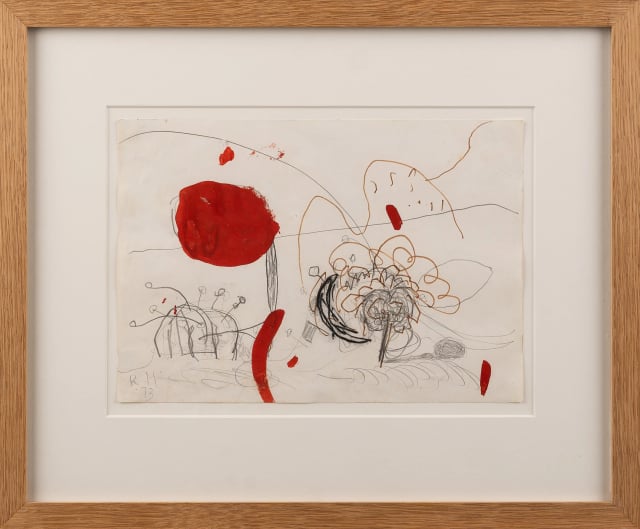
Working with vigorous brushwork, rich colour and confident line, Hilton rejected rigid geometry in favour of a more instinctive approach to painting. His work reflects the influence of European artists such as Pierre Bonnard and the CoBrA movement, while remaining unmistakably individual. Whether creating abstract compositions or his later figurative paintings, Hilton sought to express emotion and vitality rather than describe the visible world.
Within Sharpe Fine Art’s exhibition narrative, Moving to Modernism – Arriving at Abstraction, Roger Hilton represents the expressive side of British abstraction. Alongside Peter Lanyon, William Gear RA and Alan Davie, he demonstrates that abstraction could be intuitive, energetic and deeply personal as well as structured and geometric. His work enriches the story of St Ives by showing that modernism evolved through many different artistic voices, each responding to landscape, experience and imagination in their own distinctive way. Today, Hilton is recognised as one of the defining painters of post-war British art and an essential figure in the history of British abstraction.