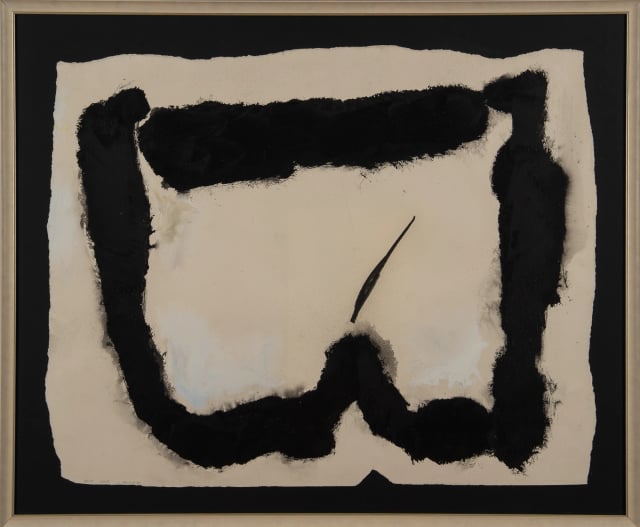
Prang

Bell’s work became distinguished by its bold structural forms and dynamic use of space. He frequently challenged the conventional rectangular format of painting, producing shaped canvases and expansive compositions in which the boundaries of the work became an integral part of the image. Although abstract, his paintings retained a strong relationship with landscape and the experience of place, an interest that continued after he moved to the United States and spent many years working in Florida.
Created in 1999, Prang demonstrates the remarkable economy and confidence of Bell’s mature work. Broad passages of dense black pigment establish a powerful, irregular boundary around an open expanse of paper, interrupted by a single sharply gestural mark. The contrast between the weight of the black forms and the openness of the central space gives the composition a striking physical tension. At nearly a metre across, the work has considerable presence despite the apparent simplicity of its means.
The work has particularly strong provenance, coming directly from the Artist’s Estate, and is documented in the literature, illustrated on page 181 of Chris Stephens’ monograph Trevor Bell. These factors make Prang an especially well-documented example of Bell’s later work.
Within Sharpe Fine Art’s exhibition narrative, Moving to Modernism – Arriving at Abstraction, Trevor Bell represents the generation that inherited the radical achievements of the established St Ives modernists and carried them towards an increasingly expansive and international form of abstraction. Alongside Peter Lanyon, Patrick Heron, Terry Frost and Roger Hilton, Bell demonstrates how the experience of landscape could be transformed into something monumental, gestural and entirely abstract. Prang, with its dramatic scale, assured handling and exceptional economy of form, provides a powerful expression of that continuing evolution.
Research and Institutional References
Historical Context
Prang belongs to a highly concentrated body of late-1990s paper-based works wherein Bell distilled fifty years of abstract experimentation into its rawest, most powerful elements. The title itself—Prang, a colloquial aviation term for a crash or a sharp impact—directly channelled the visceral, physical approach to painting that Bell inherited from his early mentor, Peter Lanyon. Rather than the fluid, liquid expanses of his Florida period, this work reflects the heavy, grounded, and weathered Cornish landscape. It captures a moment where Bell was no longer just exploring colour relationships, but using dense, muscular acrylic boundaries to trap and weaponise the negative space of the raw paper matrix.
Public Collections
His work is anchor-pinned by the Tate Collection (London & St Ives), which houses over twenty of his foundational abstract works and monumental shaped canvases, alongside permanent holdings in the British Museum, the Victoria and Albert Museum (V&A), the Arts Council Collection, and the British Council. Regionally, his paintings are preserved at The Hepworth Wakefield, the Ashmolean Museum (Oxford), the Fitzwilliam Museum (Cambridge), the Laing Art Gallery (Newcastle), and the University of Leeds.