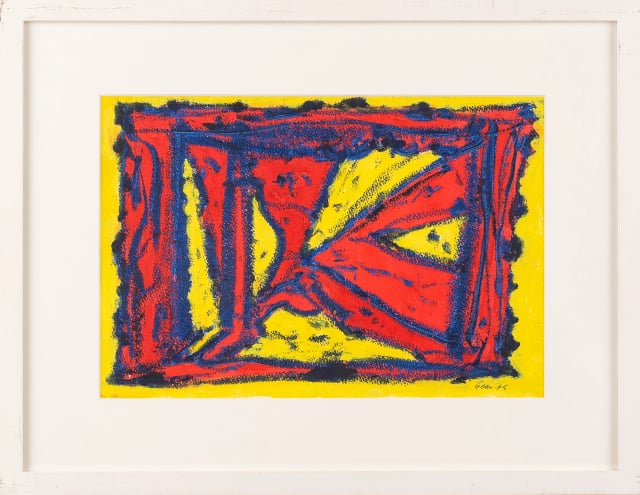
Red Curtain

Created in 1995, Red Curtain is a bold and intensely coloured example of William Gear’s late work, painted just two years before his death and during the year in which he became a Senior Royal Academician.
The composition is dominated by brilliant passages of red and yellow, articulated by vigorous lines and areas of deep blue. A strong enclosing structure frames the central forms, giving the work an architectural quality while retaining the spontaneity and expressive energy that characterised Gear’s approach to abstraction throughout his career.
The title Red Curtain offers a rare point of reference within the abstract composition. The densely worked red forms can be read as folds or divisions within a curtain, yet Gear avoids direct representation, instead transforming the subject into a dynamic arrangement of colour, texture and structure.
The striking primary palette gives the work considerable visual impact, while its vigorous handling demonstrates the vitality of Gear’s practice at the age of eighty. Signed and dated 1995, Red Curtain is a particularly vibrant example of the artist’s final period.
Research & Institutional References
Historical Context
Painted in 1995, Red Curtain dates from the final years of Gear’s career and the year in which he became a Senior Royal Academician. Despite its late date, the work retains a remarkable energy and intensity, demonstrating his continued commitment to expressive colour and abstract form while reflecting the confidence of an artist with more than five decades of international practice behind him.
Institutional Context
Works by William Gear are represented in numerous major public collections, including Tate, the National Galleries of Scotland and the Arts Council Collection, as well as important museum collections internationally.
CoBrA
After settling in Paris following the Second World War, Gear became associated with artists including Karel Appel, Constant, Corneille and Asger Jorn. He exhibited with the CoBrA group in Amsterdam and Copenhagen in 1949, establishing him as an important British participant in the development of post-war European abstraction.