Adrian Heath
Adrian Heath (1920-1992) was one of the pioneers of post-war British abstraction and an influential advocate for abstract art in Britain. After serving during the Second World War, including time as a prisoner of war, Heath became convinced that painting could move beyond representation to express ideas through colour, form and structure. During the 1950s he helped establish abstraction as a serious artistic movement, organising exhibitions, writing about modern art and exhibiting alongside many of Britain’s leading abstract painters.
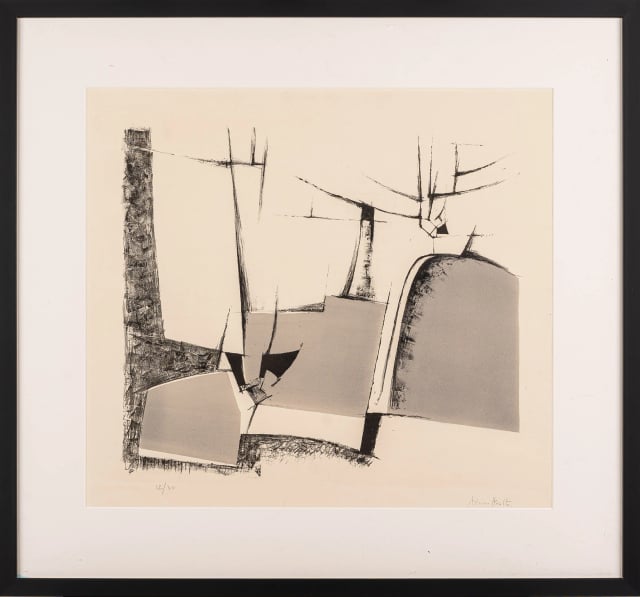
Influenced by European modernists such as Kandinsky and Mondrian, Heath developed a distinctive style built from balanced geometric forms, luminous colour and carefully structured compositions. His paintings demonstrate a belief that abstraction could communicate emotion and harmony without relying on recognisable subject matter, making him one of the most thoughtful voices of his generation.
Within Sharpe Fine Art’s exhibition narrative, Moving to Modernism – Arriving at Abstraction, Adrian Heath represents the emergence of abstraction as a confident visual language in post-war Britain. His work bridges the influence of European modernism and the flourishing of British abstraction during the 1950s and 1960s, helping to lay the foundations for artists such as Jeremy Moon, Michael Kidner and John Plumb. Today, Heath is recognised as one of the key figures who shaped the development of British abstract art.